
So because I am a glutton for punishment, I subscribe to LibraryThings advance copy giveaways. These are generally uncorrected proofs that a distributed to the kind of people who lurk on LibraryThing, namely people that publishers think will not only read the book but will be willing to write a review of it. These things are often a gamble because many of the books are written by first-time authors and the publisher is trying to get a sense of the reception of the novel before they go back for final edits. Inevitably this means that there are consistency issues in the text, which just drives me bonkers, but hey: a free book is a free book.
Most months I get a few of these and this month I received a copy of a book I have no memory of requesting, called Overseas by Beatriz Williams. The accolades printed on the front and inside covers are by authors I have never heard of, and the usual insincere note that came along with it from the publisher billed it as a "beach-read" for women who have loved books like "The Time Traveller's Wife". I was a bit put off by that because Audrey Niffineger is one of my favorite authors and I doubt many would call her novels "beach-reads".
In reading the back summary, I deduced that "Overseas" was going to be a trashy romance with some time travelling thrown in and I was correct. More surprising (possibly because I had such low expectations) it was not nearly as bad as I went in expecting. Not great, but not wretched--is that vague enough for you?
The plot of the story mainly revolves around the protagonist, Kate, a Wall Street Analyst, and her overnight romance with a billionaire tycoon, Julian Laurence, who in a bizarre story twist, turns out to be a captain from World War I, mysteriously transported through time. Seriously. I can't make this stuff up. Williams really oversimplifies the time travel aspect of the novel and doesn't waste elaborate explanations on it... the star of this novel really is the romance between the two characters, which is as expected.
Problems: Many. To be blunt I found the characters to be vastly one dimensional (Julian was good-looking and perfect, as was Kate when she wasn't shrilly flying off the handle during sudden and somewhat inexplicable emotional outbursts). Secondary characters were mainly caricatures that made you wonder if every woman on Wall Street was either a conniving bitch or a vapid socialite, while the men were mainly dogs, with Julian being the obvious exception. The book could have been substantially improved by doing away with about half the love scenes (it also would have helped length-wise... 456 pages is a bit much for a romance) and if they had to go so completely gaga over each other on every other page could there at least have been some sex? Am I alone on this?
Upsides: If I am completely honest... I totally devoured this book in a day. Yes it was trite, and clearly a classic case of a self-fulfilling fantasy on the authors part (did they really have to be rich AND pretty?), but it was a fairly original idea and she tried her best to wrap up all the loose ends. I didn't grow bored before the end or flip through any of the chapters, and I am generally not a fan of this genre. I may be biased because I do have a slight fetish for any aspect of time travel but I didn't think this was a complete waste of time.. I would be willing to read future books by this author to see if there is any improvement.
Thursday, April 19, 2012

Thursday, March 8, 2012
Spring Break Reading: The Hunger Games

Anyway, as I predicted, I was hooked by the second chapter. Come Tuesday and I was running out to Brookline Booksmith for books two (Catching Fire) and three (Mockingjay). All amazing. I finished the final book just this afternoon in a wave of tears... no further spoilers than that I promise!
I knew it was going to be a dark dystopian trilogy but one thing that was quite surprising was the violence--I'm talking non-stop, graphic, horrifying, all-out gore at many points of the books. In my mind the only thing that really makes these books YA is the fact that the protagonists are teenagers and maybe the fact that on the sex-end of things the plot is strictly PG. I'll be interested to see how the movie handles all the violence since the rating is listed as PG-13 (for what they call "intense violent thematic material and disturbing images... remember when PG-13 meant a bit of salty language?). I swear, if half of what went on in the book is going to be shown in the movie, I expect I'll come out fairly traumatized.
Nevertheless, I really enjoyed these books. The protagonist is at times as flawed and irrational as any teenage girl but also fearless and inherently likable. There are a lot of heavy themes going on in this series: about excess, power, class warfare, sacrifice... and I find myself spending a lot of time thinking about the characters--where they started and where they end up. I also have to give the author credit for managing to write in a love triangle where for once I really wasn't sure who to root for--and despite a lot of early predictions, I was still surprised by the ending. Perhaps I'll read the books again after I see the movie and see if I have a fresh perspective.
Happy Reading.
"Well, bravo!" gushes Effie Trinket. "That's the spirit of the Games!" She's pleased to finally have a district with a little action going on in it. "What's your name?" I swallow hard. "Katniss Everdeen," I say. "I bet my buttons that was your sister. Don't want her to steal all the glory, do we? Come on everybody! Let's give a big round of applause to our newest tribute!" trills Effie Trinket. To the everlasting credit of the people of District 12, not one person claps. Not even the ones holding the betting slips, the ones who are usually beyond caring. Possibly because they know me from the Hob, or knew my father, or have encountered Prim, who no one can help loving. So instead of acknowledging applause, I stand there unmoving while they take part in the boldest form of dissent they can manage. Silence. Which says we do not agree. We do not condone. All of this is wrong. Then something unexpected happens. At least, I don't expect it because I don't think of District 12 as a place that cares about me. But a shift has occurred since I stepped up to take Prim's place, and now it seems I have become someone precious. At first one, then another, then almost every member of the crowd touches the three middle fingers of their left hand to their lips and hold it out to me. It is an old and rarely used gesture of our district, occasionally seen at funerals. It means thanks, it means admiration, it means good-bye to someone you love.
Wednesday, February 29, 2012
Sad News for the Berenstain Bears
Sad news for children's lit: Jan Berenstain, co-creator of The Berenstain Bears died on Tuesday at age 88.
Who doesn't have fond memories of those books? I don't know about anyone else but my elementary school library was inundated with them. There were several televised shows made of them, first by NBC and CBS and later by PBS in Canada. When I was working as a nanny, the kids were just glued to those cartoons and strangely enough it was always reruns of the Canadian series.
The first of the books were published in the 60s and over the years the family evolved a bit.
Some of my favorite titles:


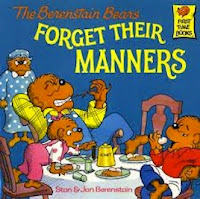


Who doesn't have fond memories of those books? I don't know about anyone else but my elementary school library was inundated with them. There were several televised shows made of them, first by NBC and CBS and later by PBS in Canada. When I was working as a nanny, the kids were just glued to those cartoons and strangely enough it was always reruns of the Canadian series.
The first of the books were published in the 60s and over the years the family evolved a bit.
Some of my favorite titles:




I think the more recent ones dealt with more modern issues but the kids I know still like some of these older ones better.
Wednesday, February 8, 2012
New Lemony Snicket Series
Egmont is publishing a new "autographical" series of books by Lemony Snickett (pen name of David Handler) to be released in 2012. The series will be called the "All the Wrong Questions" series and will contain 4 volumes, the first of which is called "Who Could That Be At This Hour?" to be released this fall. In the U.S. the books will be published by Little Brown.
Monday, January 30, 2012
Why Every Entrepreneur Should Self-Publish
I promise I will be making regular posts to this blog again moving forward, but in the meantime I wanted to post this very interesting article I read about self-publishing this morning..
http://techcrunch.com/2012/01/28/why-every-entrepreneur-should-self-publish-a-book/
http://techcrunch.com/2012/01/28/why-every-entrepreneur-should-self-publish-a-book/
Wednesday, March 23, 2011
Anticipated Fantasy Novels - Spring 2011
Okay yes. I haven't updated in forever. I suck.
Partly this is due to the fact that my reading has been embarrassingly of the escapist variety these last few months. I feel like I have a reputation to maintain :)--friends are constantly asking me, "what are you reading right now?" and I wish I could tell them it was something deep and meaningful. But the truth is, between working as much as I do, and all the projects I've taken on lately, I’ve been keeping it light in my book nook.
I’ve hit a reading slump—does anyone else ever feel that way? I’ve always been a big fan of simultaneous reading but there comes a point when you start and stop a few that just hang there, unfinished, until finally I kick myself and just read. Case in point, I’m currently stuck halfway though three amazing books:
“Extremely Loud & Incredibly Close” by Jonathan Safran Foer
“American Gods” by Neill Gaiman
“Venus in Transit” by Shirley Hazzard
All amazing. I swear. It’s this slump I tell you. Suddenly they are all sitting there, bookmarked and accusatory on my bedside table. And the “To Read” list just gets longer and more daunting. At best I have only 60 or so more years to get cracking J.
With that being said, I am reading, I’m just keeping it breezy. At the moment my pleasure reading mainly consists of fantasy novels, some with a supernatural theme running through them. I'm the first to admit that the paranormal fantasy genre has become a bit difficult to navigate ever since the advent of "Twilightmania" (ugh)--every woman out there seems to have decided to pick up a pen and write the next great vampire novel, which has resulted in a large amount of vapid dreck (snobby aren't I?).
On the other hand, after a lot of review scanning, I have managed to latch on to several fantasy authors, some new and some established, who have managed to do something new and interesting in their little corner of the fantasy genre.
The best is when you discover a great LONG series (of any genre). It gives you something to look forward to each year! I'm happy to say I have a good-sized list of authors whose books I pre-order. Some are so good that the wait until the next one is like agony (seriously… ask my friends, I moan about it a lot). Don't even get me started on a huge series like "Outlander" by Diana Gabaldon--almost three years between each book! Sometimes when I finish one I think I might die waiting.
Without further adieu, I give you my list of fantasy books to be published this spring that make me go "SQUEEEEE!!!!"
~~~
"City of Fallen Angels" (Mortal Instruments Book 4)
by Cassandra Claire
by Cassandra Claire

Publish Date: April 5, 2011
This is a fantastic series that a friend of mine turned me on to last year (thanks Jenny!). The series revolves around a girl named Clary who stumbles upon a magical group of warriors known as Shadowhunters, dedicated to eradicating demons. They come from a sort of parallel universe that exists at the edges of our own. I love this sort of urban fantasy style (a la Charles de Lint)--you know, the "if you squint a little and look sideways out of one eye you might catch a glimpse of the troll who lives under the Brooklyn bridge" sort.
You might want to lie down," Magnus advised. "I find that it helps when the crushing sense of horrible realization sets in.
-- City of Ashes (Book 2)
The Mortal Instruments was originally meant to be a trilogy but last year the author announced that there would be an additional three books continuing the story, as well as a prequel trilogy of which the first book has already been published (and enjoyed thoroughly by moi). The story is complex and never dull with plenty of action. Recently it was announced that they are casting an upcoming movie version, which I have mixed feelings about since this is technically a teen series. Other than Harry Potter and Lord of the Rings, they always seem to botch good fantasy when it comes to the movie version. Still, a good recommendation for readers of all ages—as in this is PG rated paranormal fantasy.
"Sarcasm is the last refuge of the imaginatively bankrupt."
-City of Bones (Book 1)
~~~
"Bite Club" (Morganville Vampires Book 10)
by Rachel Caine

Publish Date: May 3, 2011
Okay, this is one of those series that I avoided for a long time because it looked lame, even though it came very highly recommended by a bunch of my book groups. I finally came across one of Caine's Morganville short stories in an anthology of horror and it made me decided to give this series a chance. Man am I glad I did. This is a teen series that I recommend to a person of any age mainly because the premise is so darn creative. I also find her character dialogue spot on--it reminds me a lot of how people I know actually talked in their teens and early twenties, as in a lot of very sarcastic banter.
"No, not you two. Stay here." "Does he just not get how unfair and sexist that is?" Eve asked. "Men." "You really want to go first?" "Of course no. But I'd like the chance to refuse to go first."
- Lord of Misrule (Book 5)
Anyway, the gist of the series is that the main character, Claire, moves to a tiny town called Morganville in the middle of nowhere to attend a small college. I adore this protagonist mainly because she's an all-brain, nerdy MacGyver type--my favourite kind of chick! Claire has been accepted into college at age 16, which makes her a genius, but not very popular with her classmates. As a result of some bullying from fellow students, Claire is forced to look for off-campus housing and moves in with an eclectic bunch of misfits: Michael, Shane & Eve, who form the main cast for all of the books. The others soon enlighten Claire as to the true nature of the town--Morganville is run by a large group of vampires who control everything that happens in the town and everyone who resides there.
There is no such thing as unlimited trust. At some point, all beings with free will can, and will, betray you when you're no longer pursuing the same goals.
The crazy thing about the premise is that the vampires are fairly organized—still vicious killers—but choosing to live in relative harmony with the human, so long as they are obeyed. Every human donates blood to the cause and must be sponsored by a vampire "protector" to move freely about. The series probes some fairly dark themes when it comes to free will as Claire becomes more and more valuable to the vampires for her intelligence.
"You know, I thought you were a mousy little thing when I first saw you, Claire, but you're not, are you? Not underneath."
Oh, I am mousy," she said. "All this scares the hell out of me. But I don't know what else to do, sir, except try. Even a mouse bites."The Dead Girls’ Dance (Book 2)
When the last book (“Ghost Town”) came out, one of the reviews I read said that every time they read one of Rachel Caine's books they thought there was nowhere else to take the story and yet in every subsequent book her plots take a turn that just shocks you—very apt. I'm highly anticipating this next book and I expect great things from her in the future.
~~~
"Dead Reckoning" (Sookie Stackhouse Book 11)
by Charlaine Harris

Publish Date: May 3, 2011
Yes, this is the infamous True Blood Series. What can I say? I love it. I picked up the first one before I had ever heard of the TV show—I thought it was interesting that they were set in Louisiana. I flew through the first one and took books 2 and 3 on the plane when I flew to London and then to Paris. By the time I landed I had finished them and was desperate for the whole series. Unfortunately for me, they hadn’t been published outside of North America yet and I had to wait until we were back in the U.S. to dash out and quickly purchasing them at our local Borders. I think I scared a couple of nice booksellers in England: “You don’t understand—I have to have this book!”
Nowadays I do watch the HBO version and I love the show, but the two can’t really be compared in any useful way. Aside from a very loose character basis, and a few plot points, the show and the original novels don’t have all that much in common.
I love the tone of the books, which has a certain wry humor to it and is told entirely from the perspective of Sookie Stackhouse, a telepathic waitress in the tiny town of Bon Temps (very fictional place that is meant to be close to Shreveport, Louisiana). At the start of the series, the existence of vampire has been public knowledge for a couple of years.
"You've reached Fantasia, where the undead live again every night," "For bar hours, press one. To make a party reservation, press two. To talk to an alive person or a dead vampire, press three. Or, if you were intending to leave a humorous prank message on our answering machine, know this: we will find you."
The premise is that vampires going public has been made possible by the creation of a synthetic blood substitute called “True Blood”. Sookie gets sucked into the supernatural world as her telepathy makes her a fairly valuable commodity in various power struggles between various supernatural groups (the series involves a veritable cornucopia of werewolves, fairies and demons). Poor Sookie always ends up in the middle of everything, and let me tell you, Charlaine Harris is not gentle with her protagonists.
If I was getting harder, it was in response to the world around me.
-- Dead and Gone (Book 8)
I don’t think a single book ends without Sookie having to seek medical treatment of some kind—beaten, bitten, tortured, the list goes on. The series started out more funny and suspenseful but there has been an increasingly dark progression as the story has progressed. I wasn’t sure the character was going to bounce back after this last book but I hoping she might get a bit of a break in the upcoming installment. Charlaine Harris has only signed on to do three more books and I’m pulling for a happy ending—no heroine has earned it more. As a warning, while the series is nowhere as raunchy as the show, there are some R-ish rated parts. Violence alone… *whistles*.
I'm supposed to be a Christian, but most days I don't feel like I can even presume to say that about myself any longer. I have a lot of mad left over. When I can't sleep, I think about the other people who didn't care how much pain and trouble they caused me. And I think about how good I'd feel if they died. -- Dead in the Family (Book 10) ~~~ “Heartless” (The Parasol Protectorate Book 4) By Gail Carriger Publish Date: June 28, 2011 
This series was a real find and it continues to tickle me pink. Three words: Victorian. Paranormal. Steam punk. Who the heck comes up with something like that? Gail Carriger, that’s who. It takes place in an alternate history Victorian England where supernatural beings are accepted as part of polite society—picture Jane Austen meets Bram Stoke. The main character, Alexia Tarrabotti, has three problems: (1) she’s unmarried at the ripe old age of 25, (2) she’s half-Italian (apparently a real stain on one’s character in Victorian England), and (3) she has no soul.
Miss Tarabotti was not one of life's milk-water misses--in fact, quite the opposite. Many a gentleman had likened his first meeting with her to downing a very strong cognac when one was expecting to imbibe fruit juice--that is to say, startling and apt to leave one with a distinct burning sensation. -- Soulless (Book 1)
In this alternate universe, there are rare people, like Alexia and her father, who lack a soul. This renders her somewhat unsettling to most people and also renders any supernatural creature powerless and human when they come into contact with her. I love this character—she disturbingly forthright, frisky, and delightfully well read.
“I have died and gone to the land of bad novels.”
-- Blameless (Book 3)
These are books to make you laugh out loud. The pages are laced with what, after reading her blog, is probably Carriger’s witty personality coming through. Tons of steampunk trappings in these books: Alexia is even known for a special parasol she has designed for her that is bursting with crazy doodads, weapons and tools that can be used at a moment’s notice. Definitely a fun romp of a read.
Highland werewolves had a reputation for doing atrocious and highly unwarranted *things*, like wearing smoking jackets to the dinner table.
-- Soulless (Book 1)
~~~
“Naamah’s Blessing” (The Morin Trilogy Book 3)
By Jacqueline Carey

Publish Date: June 29, 2011
Another epic fantasy/adventure universe that I have loved for many years. I first read Carey’s Kushiel’s Dart Series, which is actually made up of two trilogies that tell one continuous story but split between two protagonists. The series is set in an alternate-history early Europe from the point of view of a young courtesan-come-spy named Phedre. Yes, the plot gets quite raunchy at times, but the plot is complex and incredibly large in scale—vast travel, espionage, violence and plenty of stunning plot twists. Phedre narrates the first three books, with her foster son, Imriel, picking up the story in the second trilogy.
When Love cast me out, it was Cruelty who took pity upon me.
-- Kushiel’s Dart (Phedre Trilogy, Book 1)
I began this third trilogy believing that the story would pick up again from where it left off and was fairly upset upon realizing that the new story was beginning from a point of time centuries past the end of “The Imriel Trilogy”. However, Carey continuous to be a fantastic storyteller and I was hooked on the new protagonist very quickly. This set focuses on a very different kind of protagonist and I was surprised that the author chose to focus this time of a woman coming from a culture and group of people that was quite vilified in the first series. I admire that she is interested in exploring all aspects of the world she has created.
We pay for sins we do not remember, and seek to do a will we can scarce fathom. That is what it is to be a god's chosen.
-- Kushiel’s Avatar (Phedre Trilogy, Book 3)
The protagonist, Morin, is of the Maghuin Dhonn, a feared and mysterious earth-dwelling tribe who worship a God that appears to them as a bear. Misfortune follows Morin throughout her life and she ends up journeying across the sea and farther in search of destiny. The Phedre and Imriel series had their protagonists traveling throughout Europe, Russia, Northern Africa and the Middle East but in the Marin trilogy the story takes place mainly on China and India, especially in the second book.
We speak of stories ending, when in truth it is we who end. The stories go on and on.
-Kushiel's Avatar (Phedre Trilogy, Book 3)
I still don’t know if I can say I like it quite as much as the very first trilogy, which I must have read a dozen times by now, but its nearly as enjoyable and I simply love a well-spun tale of adventure with a few raunchy highlights. I assume its redundant at this point that I tell you this is not a book for younger readers. Also not a book I would recommend to the easily offended.
Saturday, September 26, 2009
New Fantasy Novel by One of my Faves
 So last week I bookmarked all the books I've been working away at in order to immerse myself in Jacqueline Carey's new fantasy novel, Naamah's Kiss. In a way this is the first book in a new trilogy but it could also be considered a continuation of her previous series--all set in a alternate ancient time in a land that bears close resemblance to Europe and it's numerous nations.
 The previous novels in the series were divided into two trilogies: the first, narrated by Carey's first protagonist, Phèdre nò Delaunay de Montrève, a courtesan in a country called Terre d'Ange who is born marked by the gods and trained as a spy; it contains the novels: Kushiel's Dart, Kushiel's Chosen and Kushiel's Avatar. In the second trilogy the narration is continued by Phèdre's foster son and third heir to the d'Angeline throne, Imriel nò Montrève de la Courcel (they do love the long names), the son of an infamous traitor to the nation. The second trilogy contains the novels Kushiel's Scion, Kushiel's Justice and Kushiel's Mercy. All the books contain political intrigue, romance (and sex!), epic journeys and large and small scale battles. They really do hold all the best elements of a good fantasy novel combined.
I was a little sad when I realized that this new third trilogy was not going to contain any of the previous characters. I had really grown attached to both Phèdre and Imriel and they are only historical footnotes in this new book, but I still had high hopes for it since Carey never seems to let me down. Naamah's Kiss is set several generations past the end of the last of the Kushiel books, with a protagonist, Moirin, who is a descendant of the royalty of two different nations but who is raised by her mother's people, a wild and secretive clan of magical folk who worship a god who takes the form of a brown bear. Moirin's father was a d'Angeline priest of Naamah (the goddess of pleasure, if you will) and early on in the books she sets off across the ocean to find him. I should note that it is pretty obvious in Carey's books which nation is mean to represent which European region and Terre D'Ange (the focus of all of the earlier books) is definitely France while Alba, Moiron's birthplace, is Great Britain. The previous books have contained voyages to Skaldia (Germany), Aragonia (Spain), Hellas (Greece), Caerdicca Unitas (Italy), Menekhet (Egypt) and Khebbel-Im-Akkad (parts of the Middle East) to name a few, but Moirin eventually leaves Terre d'Ange to journey to a place that has only previously been mentioned in passing, the land of Ch'in, meant to represent China and much of the east. It seemed that Carey was striving for a different tone to this new offshoot of the series. Gone is the dark eroticism of the Kushiel books and instead the focus leaned more heavily on a sort of divine mysticism and Moirin's quest to fulfill her spiritual destiny.
I have admit I wasn't sure if I was enjoying the book for the first few chapters but I quickly became absorbed. Carey continues to have a knack for storytelling in all her books and the epic scale of the adventures she pens hasn't changed one iota. I very much enjoyed the character of Moirin though she's quite different from her d'Angeline predecessors--her people have become part of myth, shrouded in secrecy and feared by many.
Moirin is a beautiful and sensitive girl with good intentions mostly, but she is capable of wielding unthinkable magical power and many other characters in the book fear her no matter what good she does. One of my favourite aspects of her character is the fact that before she was sixteen years old she had never been inside of a building, she and her mother lived in a cave and rarely came into contact with people. As a result, Moirin is not at ease unless outdoors and finds life in ordinary society to be repressive to an unbearable degree. She has her people's gift (or curse) of being able to sense her destiny in a very literal sense, and she is driven by the demands of the gods of both countries. You really care for this character, odd as she is. I don't know if I've ever read book told from the perspective of such a profoundly lonely person, completely apart from those around her and generally misunderstood by all. Moirin does make some loyal and true friends but even they do not always completely understand her. On the other hand, gods and demons seems to have a certain fondness for her that is rather inexplicable and at times unfortunate. This is a must read for any fantasy fan.
To read more about Jacqueline Carey's works you can find information on her website.
The next installment comes out June of next year and I can't wait.
Tuesday, September 8, 2009
A Canadian First

So here is a quick review of another great Canadian contemporary novel that I recently finished (I promise to start on some New Orleans fiction soon). Mouthing the Words is the first novel written by Camilla Gibb, who has been shortlisted for her more recent works for the Scotiabank Giller Prize--the top National award for literature in Canada, for my American readers.
I haven't read any of Gibb's other work but Mouthing the Words is definitely an impressive first. I read a review in the New York Times Book Review that compared her style to that of Sylvia Plath and I couldn't agree more--think The Bell Jar with a slightly more modern twist to the prose.
The plot is of the oft-done 'girl grows up in abusive environment and dreams of escape' type, but Gibb's insight into her protagonist's deeply damaged psyche is unrivaled. Thelma, who we first meet as a child, withdraws into her own fantasy world to escape her sexually abusive father and her emotionally-absent mother, but loses track of the separation between fantasy and reality as she grows older. This eventual borderline personality disorder doesn't stop the brilliant Thelma from eventually pursuing her ambitions of a career in law.
This might sound like a very depressing story but in fact the book is often hilariously funny and engaging, with a constant cast of Thelma's imaginary companions who often have a lot to say on the state of things. Mouthing the Words will disturb you, anger you, and above all entertain you--glad to see that Ontario is still keeping up it's tradition of producing bright literary talent. Must read!
We trust that we know to be normal is normal simply because it is known to us. Worlds meet in collisions and the coherence of our histories crumbles. I feel it in the blank looks I tend to receive at dinner parties. When other people recount stories, I habitually interject with statements like, "Oh yeah, I know exactly what you mean. I used to feel just like that when my father held me over the bridge by my armpits." Eyes previously animated are suddenly staring soberly. "You know?" I might add hopefully. "That bridge over the Don River?" A gracious dinner party host might break the uncomfortable moment with some tactfully placed suggestion of more Stilton. And if I had a lover, this would be the perfect moment to give me a reassuring squeeze of the thigh under the table and whisper something in my ear like, "It's OK, dear. Just try not to talk."
Monday, August 10, 2009
An Uncommon Reader
I haven't been getting that much reading done in the last few weeks as work has been pretty crazy in the lead-up to my trip to Canada. Instead, I've been re-reading a few favourites and slowly working my way through A Middle Place by Kelly Corrigan--a memoir about cancer that is so sad in places that I can only handle one chapter at a time.
 Last weekend I returned to one of my favourite essay collections, Anne Fadiman's Ex Libris: Confessions of a Common Reader. I love books about reading and bookworms because for a very long time as a child I really thought I was the only one--the only really crazy one, I mean. On the first page of Fadiman's introduction she says, "There is a certain kind of child who awakens from a book as from an abyssal sleep, swimming heavily up through layers of consciousness toward a reality that seems less real than the dream-state that has been left behind. I was such a child." So was I; and I find Fadiman's dry and witty stories about her own particular brand of mania the ultimate reassurance regarding my own dubious addiction (because hers is ten times worse!).
Fadiman is the daughter of the famous literary critic and scholar, Clifton Fadiman; her Mother, Annalee, was a foreign correspondent in World War II; and she is married to American author George Howe Colt. I love her descriptions of her family's shared book-insanity and constant discussions of all things literary. One of my favourites in the collection is "Marrying Libraries" which recounts her and her husband's attempt to consolidate their vast libraries, decide whose extra copies should be discarded, and above all, choose how everything should be sorted:
Fadiman also delves into the topic of gender, always a draw for me, in her essays "True Womanhood" and "The His'er Problem". The latter was particularly good reading and had me in stitches when Fadiman described a job interview she had once for a summer job at the New Yorker where the editor asked her what sorts of magazines she would like to work for. When she got to the new woman's magazine "Ms.", she realized she didn't know how to pronounce, the then new neutral female word and instead referred to it as "em ess". The editor, rather than point out her error, proceeded to discuss that particular magazine without ever once referring to its title:
There is also a recommended books section at the back of Confessions of a Common Reader that I found very useful, with many of Fadiman's own favourite books about books. If you consider yourself a bookworm, this volume is definitely worth owning.
 Last weekend I returned to one of my favourite essay collections, Anne Fadiman's Ex Libris: Confessions of a Common Reader. I love books about reading and bookworms because for a very long time as a child I really thought I was the only one--the only really crazy one, I mean. On the first page of Fadiman's introduction she says, "There is a certain kind of child who awakens from a book as from an abyssal sleep, swimming heavily up through layers of consciousness toward a reality that seems less real than the dream-state that has been left behind. I was such a child." So was I; and I find Fadiman's dry and witty stories about her own particular brand of mania the ultimate reassurance regarding my own dubious addiction (because hers is ten times worse!).
Fadiman is the daughter of the famous literary critic and scholar, Clifton Fadiman; her Mother, Annalee, was a foreign correspondent in World War II; and she is married to American author George Howe Colt. I love her descriptions of her family's shared book-insanity and constant discussions of all things literary. One of my favourites in the collection is "Marrying Libraries" which recounts her and her husband's attempt to consolidate their vast libraries, decide whose extra copies should be discarded, and above all, choose how everything should be sorted:
"'You mean we're going to be chronological within each author?' he gasped. 'But no one even knows for sure when Shakespeare wrote his plays!'Another good essay is "Never Do That to a Book", which compares people that asthetically love books with people that carnivorously devour them with no qualm against defacing the book in the process (guess which one I am?). Equally interesting is "Nothing New Under the Sun" which explores the topic of plagiarism in all its forms.
'Well,' I blustered, 'we know he wrote Romeo and Juliet before The Tempest. I'd like to see that reflected on our shelves.'
George says that was one of the few times he has seriously contemplated divorce.
Fadiman also delves into the topic of gender, always a draw for me, in her essays "True Womanhood" and "The His'er Problem". The latter was particularly good reading and had me in stitches when Fadiman described a job interview she had once for a summer job at the New Yorker where the editor asked her what sorts of magazines she would like to work for. When she got to the new woman's magazine "Ms.", she realized she didn't know how to pronounce, the then new neutral female word and instead referred to it as "em ess". The editor, rather than point out her error, proceeded to discuss that particular magazine without ever once referring to its title:
"Since that time, whenever I have heard anyone talk about civility, I have thought of Mr. Shawn, a man so civil that, in order to spare me embarrassment, he succeeded in crossing a potential minefield of potential Ms.'s without detonating a single one... After I left the building I called a friend. ('How do you say that new little word?... Oh my God, no!') That was a terrible moment, but as Mr. Shawn had surmised, wanting to die in a telephone booth was greatly preferable to wanting to die in his office."The rest of that essay explores Fadiman's conflicting feelings regarding gender neutral language that is at once fair, but not necessarily poetic.
There is also a recommended books section at the back of Confessions of a Common Reader that I found very useful, with many of Fadiman's own favourite books about books. If you consider yourself a bookworm, this volume is definitely worth owning.
"Books wrote our life story, and as they accumulated on our shelves (and on our windowsills, and underneath our sofa, and on top of our refrigerator), they became chapters in it themselves. How could it be otherwise?"
Wednesday, July 22, 2009
Vampires with a twist

I started watching True Blood when HBO was showing repeats of the first season in the lead up to the premiere of the second season. For a complete recounting of my little obsession with the show please see my other blog, Le Bon Temps. The show made me curious about the series it’s based on, The Southern Vampire Mysteries, by Charlaine Harris, because seeing as I live in Louisiana, where the story is set, it’s hard not to have heard about the books. The local Borders always has a little display them in the “Louisiana fiction” section and the covers were so unique that I came very close to picking them up several times before I caught the True Blood bug.

So I picked up the first book, Dead Until Dark, and started reading. Even though I knew the basic plot of the first novel through watching the show I was completely hooked on this series within the first few chapters. I had just had to read the rest after that. It’s hard not to be in the story: Charlaine Harris has the kind of writing style that is perfect for this kind of fantasy/mystery genre. She really doesn’t waste much time in getting to the action in her books and almost every chapter has it’s own mini-climax with plenty of crazy plot twists.
"I could tell Hugo was convinced that he would get to walk back up these stairs: after all, he was a civilized person. These were all civilized people. Hugo really couldn't imagine that anything irreparable could happen to him, because he was a middle-class white American with a college education, as were all the people on the stairs with us. I had no such conviction. I was not a wholly civilized person."
 I’m someone who has always loved vampire novels, from Stoker’s Dracula to, more recently Elizabeth Kostova’s The Historian; I’ve even dabbled in Anne Rice on occasion, so I know the run-of-the-mill vampire cliches. Let me tell you, Southern Vampire really turns a lot of them on their head. Harris creates a world in which a multitude of supernatural species live alongside rather naive humans: vampires, shapeshifters, werewolves and even fairies. At the start of the first novel, the vampires have “been out of the coffin”, so to speak, to the human populace for two years, since the invention of a Japanese synthetic substance called True Blood, which allows vampires to survive without having to drink the blood of humans–in theory… duh duh duh.
Enter our protagonist, Miss Sookie Stackhouse, barmaid and reluctant telepath in the small and very fictional town of Bon Temps, whose neighbours have considered her the town crazy since childhood, and who has been hoping, for two years, that she might get to meet a real live vampire. On the very first page of the first novel (I told you, Harris works fast), she gets her wish in the form of Bill Compton, a rather stoic vampire who is attempting to “mainstream”, as the vampires put it, by moving back to his hometown and living amongst its human citizens. Sookie and Bill immediately become romantically entangled and Sookie gets pulled into the rather murky world of vampire politics and intrigue. From that point on the poor girl pretty much gets the crap kicked out of her on a semi-regular basis – seriously, not a single novel passes that doesn’t end with Sookie flat on her back in a hospital somewhere.
 The series so far consists of nine books, Dead Until Dark, Living Dead in Dallas, Club Dead, Dead to the World, Dead as a Doornail, Definitely Dead, All Together Dead, From Dead to Worse, and Dead and Gone. I’m sure you can see a theme here. Each book has its own self-contained mystery or adventure but also builds up the increasing complexity of Sookie’s ever-broadening world – new species to contend with, new vampire political struggles. Basically you could read each novel as a stand-alone and muddle through but you’d be confused beyond what can be explained in the brief recap at the beginning of each book.
What sets the series apart from other mystery or fantasy for me is the humour with which Harris writes all of her characters. Now that I’ve read the books I infinitely prefer the Sookie of the novel to her TV counterpart. It’s no offense against Anna Paquin or the show at all, I just find that they sort of overdo the whole southern charm thing–Sookie sort of ends up coming off as a bit of a bimbo–whereas in the books she still has that polite southern belle element but she’s also sarcastic and increasingly pragmatic about the sort of horrors she is exposed to as the books go on. I like that she’s unflappable.
 Bill is a character I really can’t stand in either format because he’s your typical tortured soul style vampire made so famous by Louis in “Interview with the Vampire”, which I find gets very old, very fast, and then you just want him to scram. Like most fans of this series I absolutely adore the character of Eric, the 1000-year old vampire who acts as leader of Northern Louisiana, but he doesn’t really become a major character until the fourth book and on the show he’s still coming off as one of the bad guys–I still have high hopes. Both he and his second in command Pam are favourite characters of mine because they so enjoy their undead lives (no pun intended) and keep a sense of humour in even the most bizarre of circumstances (and there are plenty).
"'I read a policeman's mind,' I muttered. I snuck a look to see how Eric was taking this, and he was staring at me the same way the Monroe vampires had. Thoughtful. Hungry.
"That's interesting," he said. "I had a psychic once. It was incredible."
"Did the psychic think so?"
Eric laughed. "For a while."

Also there is sex. Lots and lots of sex. That seems to be a real sticker with the book and show–these vampires are very horny. And as we all know, sex can only improve a book J
There are nine books so far plus several shorts stories that fall between the novels and Harris has said there will be at least four more before she finishes with Sookie. I can’t recommend these books more and I can say with complete confidence that this series has absolutely made my year. Read it!
Wednesday, July 8, 2009
Transatlantic flight reading
Sorry for the long gap between posts. The big trip to France took up most of June, if you count all the packing and unpacking and sleeping off the jet lag. On our way to Nice we were delayed in London for 24 hours which was not too bad at all since the airline picked up the tab. We took the red eye across to London so I really didn't do much reading on that leg of the journey; aside from a few trashy romances, I mainly slipped in and out of consciousness until we arrived. Once we arrived in France there was too much to see and do to do more than peak at the books I'd brought along.
On the way back, however, I was in the mood for something funny so I started reading the first book in the Thursday Next series, called The Eyre Affair by Jasper Fforde. Several years ago I was on a trip somewhere with my family, I think to Costa Rica, and I was going through books like crazy since we were spending a lot of time being driven from once place to another. So my sister let me read a few that she had brought along and one of these was another Thursday Next novel somewhere in the middle of the series. I enjoyed it a lot but this is a series with a lot of complicated plot twists and I admit to being a little lost with some of the references in the book to what had happened previously. I meant to look for the rest of the series when we got home but, typically, I got distracted by some other book and forgot all about it until I re-discovered it, like some vacation-reading holy grail, on a cart being pushed by a very sweet librarian.


It turns out that the New Orleans public library has the complete Thursday Next series on their shelves, which might not seem so miraculous in any other city but down here whenever I type something into the search engine I know that dreaded "damaged in Katrina" is gonna pop up somewhere. So it seemed like divine literary intervention, if you know what I mean, and I made sure to pack that book in my carry on.
It's definitely just as funny as I remembered. It's irreverent, witty and the absolute perfect book for literature lovers. In fact being at least familiar with the great works of literature is a bit of a prerequisite to getting a lot of the humour in Thursday Next's world, which is sort of an alternate-history/fantasy nod to the written word.
 In her world, England is republic with a rather totalitarian method of policing its citizens and conducting its affairs abroad. The country has been bailed out of the World Wars by a giant corporation called Goliath, which now almost runs England and controls its media. The other important difference is that literature, especially the classics, are valued deeply and taken very very seriously. Books are bigger than movies or television and authors are revered far more than any celebrity. Enter Thursday Next, literary detective, war veteran and bookworm extraordinaire. She quickly becomes embroiled in trying to catch a villain intent on blackmailing the government by kidnapping literary figures from their books: including Jane Eyre herself. The book blurs the lines between fantasy and reality but never takes itself too seriously (expect many puns). I think the series continues on for at least six more books after the first so I'm looking forward to reading the sequels when I get a chance.
On the way back, however, I was in the mood for something funny so I started reading the first book in the Thursday Next series, called The Eyre Affair by Jasper Fforde. Several years ago I was on a trip somewhere with my family, I think to Costa Rica, and I was going through books like crazy since we were spending a lot of time being driven from once place to another. So my sister let me read a few that she had brought along and one of these was another Thursday Next novel somewhere in the middle of the series. I enjoyed it a lot but this is a series with a lot of complicated plot twists and I admit to being a little lost with some of the references in the book to what had happened previously. I meant to look for the rest of the series when we got home but, typically, I got distracted by some other book and forgot all about it until I re-discovered it, like some vacation-reading holy grail, on a cart being pushed by a very sweet librarian.
It turns out that the New Orleans public library has the complete Thursday Next series on their shelves, which might not seem so miraculous in any other city but down here whenever I type something into the search engine I know that dreaded "damaged in Katrina" is gonna pop up somewhere. So it seemed like divine literary intervention, if you know what I mean, and I made sure to pack that book in my carry on.
It's definitely just as funny as I remembered. It's irreverent, witty and the absolute perfect book for literature lovers. In fact being at least familiar with the great works of literature is a bit of a prerequisite to getting a lot of the humour in Thursday Next's world, which is sort of an alternate-history/fantasy nod to the written word.
 In her world, England is republic with a rather totalitarian method of policing its citizens and conducting its affairs abroad. The country has been bailed out of the World Wars by a giant corporation called Goliath, which now almost runs England and controls its media. The other important difference is that literature, especially the classics, are valued deeply and taken very very seriously. Books are bigger than movies or television and authors are revered far more than any celebrity. Enter Thursday Next, literary detective, war veteran and bookworm extraordinaire. She quickly becomes embroiled in trying to catch a villain intent on blackmailing the government by kidnapping literary figures from their books: including Jane Eyre herself. The book blurs the lines between fantasy and reality but never takes itself too seriously (expect many puns). I think the series continues on for at least six more books after the first so I'm looking forward to reading the sequels when I get a chance.
"I'm not mad. I'm just...well, differently moralled, that's all."
"I shouldn't believe anything I say, if I were you-and that includes what I just told you."
Monday, May 18, 2009
Ten contemporary novels that'll rock your world.
Might as well start this blog off with a bang. I've put together a list of ten books, spanning several decades and genres, that I have found myself thinking about long after they'd been shelved. Some are fond childhood friend and some I've only recently discovered, but all are definitely worth reading. Something for everyone, I promise.
1. The Book of Daniel, E.L. Doctorow (1971)
 I'm a big fan of Doctorow but this is by far my favourite of all his works. It's meant to be very loosely based on the Rosenberg trials (the famous couple executed at the height of communist fear in America for supposedly selling national secrets to the Soviets) though the differences are distinct enough that the book doesn't quite qualify as direct historical fiction. The story, though not chronological or particularly coherent, focuses on the son of the so-called spies as he begins to examine his parent's trial and the impact that it had on the lives of himself and his sister, Susan, who has attempted suicide and resides in a mental facility. Honestly, this is a very difficult book to summarize because it skips around in time and topic with Daniel's own thoughts and memories and much of it is a sort of philosophical consideration of America as a nation. The book is about one family and one man but its also the most insightful novel about the upheaval of the 50s and 60s that I've ever read. I especially encourage people to read in now - in the light of more recent political upheaval, the book takes on a new significance.
2. The Handmaid's Tale, Margaret Atwood (1985)
 And of course we come to Atwood, that reliable rock star of Canadian literature. I've read most of her work from The Edible Woman to Oryx and Crake but I inevitably return to this beautifully written dystopia. The protagonist is Offred, a woman living in a religious dictatorship known as the Republic of Gilead, once called the United States of America. The book alternates between her memories of the world that was (the world we are familiar with) and the world that is - a world in which women's minds and bodies are strictly controlled and rigid hierarchy enforced. There is something about the way that this novel is written, dreamy and sometimes apathetic, that unsettles you as you're reading it. I once went through one of my copies and tried to underline all the really great lines - made my book pretty messy - there is at least one amazing, unforgettable line in every chapter of this book.
 A few years ago I saw a friend reading this book and was completely shocked at how big it was. I mean I love big books (and I cannot lie), but this was easily one of the heftiest books I'd ever laid eyes on. My friend swore up and down that it was the most absorbing thing she'd read all year so I went out and bought it the next day... and didn't come up for air for 24 hours. This novel is a serious contender for the greatest vampire novel ever written, Bram Stoker included. It's a mammoth-sized tome that takes you through most of Western and Eastern Europe on the hunt for the real deal: Dracula himself. This is definitely a mystery/horror/adventure novel for history buffs as the title implies - the protagonists spend a great deal of time pouring over dusty books in even dustier libraries. The most amazing part of it is that this is Kostova's first book, though it's more like five books in one. She must have had to do YEARS of research to write this thing: customs, language, myths, superstitions - everything is written with such detail that the supernatural aspect of the book seems almost plausible. Very scary.
4. Jacob Have I Loved, Katherine Paterson (1981)
 A book that falls under my "childhood friends" category. I think I must have read this for the first time when I was around ten or eleven years old - a battered old copy from my school library. It's the story of a young girl growing up in an isolated island community who is sort of perpetually overshadowed by her twin sister. It's not too long and a fairly straightforward story but the prose is beautiful and the ending always makes me cry. I have such a fondness for the books that kept me company when I was small - it's like a hug from an old friend whenever you read them again.
 binson (2002)
This book was assigned reading in Literature For Our Time, the fist year English course at the University of Toronto, taught by the brilliant Professor Nick Mount. In fact much of the books that almost made it only this list were also recommended by him but this book is one that I still think about all these year later. The novel falls into the category of literature I love most: magical realism. Lisamarie, a young girl growing up in the isolated Haisla village of Kittamaat, leads a relatively normal, if troubled life, aside from the fact that she receives the occasional visit from a sort of trickster spirit who acts as a portent of tragedy to come. She finds herself in the unfortunate position of vaguely knowing the future without the power to change it, and inevitably feels responsible when harm comes to her family. We were lucky in my class to actually receive a visit from the author herself, and let me tell you, she was the not the kind of person you picture sitting down to write a novel as dark in tone as this one - she was so bubbly and affable and loved answering our questions - in fact, several of her answers about the hidden nuances in the text surprised me so its a book that needs to be read a few times to understand some of the subtle details she weaves in.
6. Outlander, Diana Gabaldon (1998)
 Every time I try to summarize this novel (the first in a series) when I'm recommending it I draw a blank because nothing I can say does it justice without making it sound rather cheesy, and it's anything but. Suffice it to say that this book spans several genres: romance, adventure, and historical fiction with a teaspoon of fantasy thrown into the mix in the form of time-travel. The first couple of novels take place during the Scottish Uprisings of the 1700s (during which most of the Highland clans were wiped out) but in later books the protagonists travel to the New World and eventually become embroiled in the American Revolution - so lots of fun for history buffs but also very acessible for someone who knows nothing about those events. This would also make a great summer vacation read since it grabs you from the get go and makes for great escapism. It's easily the novel that I have re-read the most times (somewhere around 30 or so times, I would say) and I cannot praise it more. Read this book!
7. The Romantic, Barbara Gowdy (2003)
 Another Canadian author! And a book set in dear old Toronto... Woot!
Anything by Gowdy is worth reading honestly but I feel this is one of her best. As the title implies, the story revolves around love and a young girl named Louise who is desperate for love from any source. Louise's mother, a former beauty queen, disappears one day when her daughter is nine, leaving only a note that reads, "Louise knows how to work the washing machine" - a perfect example of Gowdy's biting and ironic humour. A warning to readers: this is not a happy tale by any stretch of the imagination and I frequently go through a box of Kleenex while reading it. For these characters love turns out not to be enough.
 Soon to be a movie, starring Rachel McAdams, that I am eagerly anticipating. I have no idea when it comes out - every time I check it still says "in production" and I first heard about it two years ago! I'm very curious to see how on earth they turn this book into a movie because even summarizing it is going to give me a headache. The first time I finished reading it I had to immediately start it over so I could begin to unravel who was where and when and at what point. Still, for all the confusing chronological jumping around in time, this story is absolutely mesmerizing. The plot centres around Henry, a young librarian who has a genetic disorder that causes him to be periodically displaced in time, and his wife Claire, whom he meets on these travels. There is so much more to it than that, including random instances of vast age differences between the characters, but there is no way to explain it here without confusing everyone. Suffice it to say that theirs is not a typical marriage and this is not a typical romance. Read it!
9. A Town Like Alice, Neville Shute (1976)
 I actually saw the TV mini-series made of this before I read the book. They are both excellent and the movie really cuts out nothing of the plot - it's about nine hours of watching, though. Since then I've read a lot of Neville Shute (On the Beach is another great) but this remains my favourite. Its also much easier to summarize than most of the other books on this list: The story is sort of two stories, really, narrated by a lawyer who happens to meet the protagonist in the course of carrying out her uncle's will. The first half of the story is recounted to the narrator by the protagonist, Jean, as she describes her experience during the war. She was part of a group of British women and children who are captured by the Japanese in Malaysia during World War II. They were forced to march from town to town, walking all day, because the Japanese had no womens' camp set up in the country - so they just march this group around for three years. Along the way, Jean meets a young Australian prisoner, who steals some chickens to help feed the women and is, she thinks, executed for it. At least half of the original number die, including all of the Japanese guards assigned to them. When the last guard dies, the group decides to stay at their last stop, an isolated Malaysian village, and work in the rice patties until the war is over. Which they do. End story one. The second-half of the book begins with Jean discovering, on a trip back to Malaysia, that the Australian prisoner has actually survived the war. So she heads off to the Australian outback to track him down. I won't tell you any more - suffice it to say, it's quite the epic novel. Shute's stories always have the feeling of a really good story told round a campfire, complete with lovely, faintly nostalgic endings:
 (2004)
This is a bittersweet pick for me so I'm glad it ended up coming last alphabetically (which is how I organized them, for fairness sake). I discovered her first work, Circling the Drain (Short Stories), in a random bin at some random bookstore in some random city in California - true story. I was hooked from the get go. Her stories were completely different from anything I'd read before, and in fact they were completely different from each other. It was a very surprising first work for such a young woman. So when I stumbled across her novel three years ago I was ecstatic, until I noticed the Afterward by Michael Chabon which lamented her death in a plane crash with her entire family two months before the book's publication. I can't tell you how saddened I was - this was an author who would have gone on to write some amazing stuff and to lose someone so talented so young is a big loss for the literary world. This novel is a sort of continuation of one of the stories in her collection: A young girl, Faith, struggles to return to normalcy after a breakdown but is haunted by bitter, sarcastic hallucinations of her formerly fat self. She eventually snaps and commits some disturbing violence before running of and joining a circus -- definitely not your typical coming of age story. The afterward by Michael Chabon is also not to be skipped as its possibly one of the most touching, heartbreaking tributes to a lost friend, and lost talent, that I've ever read.
So there's the big first list. After this I will most likely stick to reviewing one at a time but I thought this would be a good way to get the blog started and demonstrate the sort of books I read. My hope is that someone will pick up one of these books and make a new discovery.
1. The Book of Daniel, E.L. Doctorow (1971)
 I'm a big fan of Doctorow but this is by far my favourite of all his works. It's meant to be very loosely based on the Rosenberg trials (the famous couple executed at the height of communist fear in America for supposedly selling national secrets to the Soviets) though the differences are distinct enough that the book doesn't quite qualify as direct historical fiction. The story, though not chronological or particularly coherent, focuses on the son of the so-called spies as he begins to examine his parent's trial and the impact that it had on the lives of himself and his sister, Susan, who has attempted suicide and resides in a mental facility. Honestly, this is a very difficult book to summarize because it skips around in time and topic with Daniel's own thoughts and memories and much of it is a sort of philosophical consideration of America as a nation. The book is about one family and one man but its also the most insightful novel about the upheaval of the 50s and 60s that I've ever read. I especially encourage people to read in now - in the light of more recent political upheaval, the book takes on a new significance.
2. The Handmaid's Tale, Margaret Atwood (1985)
 And of course we come to Atwood, that reliable rock star of Canadian literature. I've read most of her work from The Edible Woman to Oryx and Crake but I inevitably return to this beautifully written dystopia. The protagonist is Offred, a woman living in a religious dictatorship known as the Republic of Gilead, once called the United States of America. The book alternates between her memories of the world that was (the world we are familiar with) and the world that is - a world in which women's minds and bodies are strictly controlled and rigid hierarchy enforced. There is something about the way that this novel is written, dreamy and sometimes apathetic, that unsettles you as you're reading it. I once went through one of my copies and tried to underline all the really great lines - made my book pretty messy - there is at least one amazing, unforgettable line in every chapter of this book.
Maybe none of this is about control. Maybe it isn't really about who can own whom, who can do what to whom and get away with it, even as far as death. Maybe it isn't about who can sit and who has to kneel or stand or lie down, legs spread open. Maybe it's about who can do what to whom and be forgiven for it. Never tell me it amounts to the same thing.3. The Historian, Elizabeth Kostova (2005)
 A few years ago I saw a friend reading this book and was completely shocked at how big it was. I mean I love big books (and I cannot lie), but this was easily one of the heftiest books I'd ever laid eyes on. My friend swore up and down that it was the most absorbing thing she'd read all year so I went out and bought it the next day... and didn't come up for air for 24 hours. This novel is a serious contender for the greatest vampire novel ever written, Bram Stoker included. It's a mammoth-sized tome that takes you through most of Western and Eastern Europe on the hunt for the real deal: Dracula himself. This is definitely a mystery/horror/adventure novel for history buffs as the title implies - the protagonists spend a great deal of time pouring over dusty books in even dustier libraries. The most amazing part of it is that this is Kostova's first book, though it's more like five books in one. She must have had to do YEARS of research to write this thing: customs, language, myths, superstitions - everything is written with such detail that the supernatural aspect of the book seems almost plausible. Very scary.
4. Jacob Have I Loved, Katherine Paterson (1981)
 A book that falls under my "childhood friends" category. I think I must have read this for the first time when I was around ten or eleven years old - a battered old copy from my school library. It's the story of a young girl growing up in an isolated island community who is sort of perpetually overshadowed by her twin sister. It's not too long and a fairly straightforward story but the prose is beautiful and the ending always makes me cry. I have such a fondness for the books that kept me company when I was small - it's like a hug from an old friend whenever you read them again.
We slept in the same room, ate at the same table, sat for nine months out of each year in the same classroom, but none of these had made us close. How could they, when being conceived at the same time in the same womb had done nothing to bind us together? And yet, if we were not close, why did only Caroline have the power, with a single glance, to slice my flesh clear to the bone?5. Monkey Beach, Eden Ro
 binson (2002)
This book was assigned reading in Literature For Our Time, the fist year English course at the University of Toronto, taught by the brilliant Professor Nick Mount. In fact much of the books that almost made it only this list were also recommended by him but this book is one that I still think about all these year later. The novel falls into the category of literature I love most: magical realism. Lisamarie, a young girl growing up in the isolated Haisla village of Kittamaat, leads a relatively normal, if troubled life, aside from the fact that she receives the occasional visit from a sort of trickster spirit who acts as a portent of tragedy to come. She finds herself in the unfortunate position of vaguely knowing the future without the power to change it, and inevitably feels responsible when harm comes to her family. We were lucky in my class to actually receive a visit from the author herself, and let me tell you, she was the not the kind of person you picture sitting down to write a novel as dark in tone as this one - she was so bubbly and affable and loved answering our questions - in fact, several of her answers about the hidden nuances in the text surprised me so its a book that needs to be read a few times to understand some of the subtle details she weaves in.
6. Outlander, Diana Gabaldon (1998)
 Every time I try to summarize this novel (the first in a series) when I'm recommending it I draw a blank because nothing I can say does it justice without making it sound rather cheesy, and it's anything but. Suffice it to say that this book spans several genres: romance, adventure, and historical fiction with a teaspoon of fantasy thrown into the mix in the form of time-travel. The first couple of novels take place during the Scottish Uprisings of the 1700s (during which most of the Highland clans were wiped out) but in later books the protagonists travel to the New World and eventually become embroiled in the American Revolution - so lots of fun for history buffs but also very acessible for someone who knows nothing about those events. This would also make a great summer vacation read since it grabs you from the get go and makes for great escapism. It's easily the novel that I have re-read the most times (somewhere around 30 or so times, I would say) and I cannot praise it more. Read this book!
7. The Romantic, Barbara Gowdy (2003)
 Another Canadian author! And a book set in dear old Toronto... Woot!
Anything by Gowdy is worth reading honestly but I feel this is one of her best. As the title implies, the story revolves around love and a young girl named Louise who is desperate for love from any source. Louise's mother, a former beauty queen, disappears one day when her daughter is nine, leaving only a note that reads, "Louise knows how to work the washing machine" - a perfect example of Gowdy's biting and ironic humour. A warning to readers: this is not a happy tale by any stretch of the imagination and I frequently go through a box of Kleenex while reading it. For these characters love turns out not to be enough.
I'm sure that my mother, at least, would say I'd got it all wrong. Abel might think I'd got it all wrong, too, except he wouldn't care. Looking back over his life never came easily to him, and for the sake of avoiding that ordeal--but also because, ultimately, he attached himself to nothing--he'd surrender to anyone's memories of him. Even mine, these pawed-over resurrections. Even though he knew I loved him too desperately to ever be a reliable witness.8. The Time Traveler's Wife, Audrey Niffenegger (2003)
 Soon to be a movie, starring Rachel McAdams, that I am eagerly anticipating. I have no idea when it comes out - every time I check it still says "in production" and I first heard about it two years ago! I'm very curious to see how on earth they turn this book into a movie because even summarizing it is going to give me a headache. The first time I finished reading it I had to immediately start it over so I could begin to unravel who was where and when and at what point. Still, for all the confusing chronological jumping around in time, this story is absolutely mesmerizing. The plot centres around Henry, a young librarian who has a genetic disorder that causes him to be periodically displaced in time, and his wife Claire, whom he meets on these travels. There is so much more to it than that, including random instances of vast age differences between the characters, but there is no way to explain it here without confusing everyone. Suffice it to say that theirs is not a typical marriage and this is not a typical romance. Read it!
9. A Town Like Alice, Neville Shute (1976)
 I actually saw the TV mini-series made of this before I read the book. They are both excellent and the movie really cuts out nothing of the plot - it's about nine hours of watching, though. Since then I've read a lot of Neville Shute (On the Beach is another great) but this remains my favourite. Its also much easier to summarize than most of the other books on this list: The story is sort of two stories, really, narrated by a lawyer who happens to meet the protagonist in the course of carrying out her uncle's will. The first half of the story is recounted to the narrator by the protagonist, Jean, as she describes her experience during the war. She was part of a group of British women and children who are captured by the Japanese in Malaysia during World War II. They were forced to march from town to town, walking all day, because the Japanese had no womens' camp set up in the country - so they just march this group around for three years. Along the way, Jean meets a young Australian prisoner, who steals some chickens to help feed the women and is, she thinks, executed for it. At least half of the original number die, including all of the Japanese guards assigned to them. When the last guard dies, the group decides to stay at their last stop, an isolated Malaysian village, and work in the rice patties until the war is over. Which they do. End story one. The second-half of the book begins with Jean discovering, on a trip back to Malaysia, that the Australian prisoner has actually survived the war. So she heads off to the Australian outback to track him down. I won't tell you any more - suffice it to say, it's quite the epic novel. Shute's stories always have the feeling of a really good story told round a campfire, complete with lovely, faintly nostalgic endings:
"I have sat here day after day this winter, sleeping a good deal in my chair, hardly knowing if I was in London or the Gulf Country, dreaming of the blazing sunshine, of poddy dodging and black stock riders, or Cairns and of Green Island. Of a girl I met forty years too late, and of her life in that small town that I shall never see again, that hold so much of my affection."10. Wonder When You'll Miss Me, Amanda Davis
 (2004)
This is a bittersweet pick for me so I'm glad it ended up coming last alphabetically (which is how I organized them, for fairness sake). I discovered her first work, Circling the Drain (Short Stories), in a random bin at some random bookstore in some random city in California - true story. I was hooked from the get go. Her stories were completely different from anything I'd read before, and in fact they were completely different from each other. It was a very surprising first work for such a young woman. So when I stumbled across her novel three years ago I was ecstatic, until I noticed the Afterward by Michael Chabon which lamented her death in a plane crash with her entire family two months before the book's publication. I can't tell you how saddened I was - this was an author who would have gone on to write some amazing stuff and to lose someone so talented so young is a big loss for the literary world. This novel is a sort of continuation of one of the stories in her collection: A young girl, Faith, struggles to return to normalcy after a breakdown but is haunted by bitter, sarcastic hallucinations of her formerly fat self. She eventually snaps and commits some disturbing violence before running of and joining a circus -- definitely not your typical coming of age story. The afterward by Michael Chabon is also not to be skipped as its possibly one of the most touching, heartbreaking tributes to a lost friend, and lost talent, that I've ever read.
So there's the big first list. After this I will most likely stick to reviewing one at a time but I thought this would be a good way to get the blog started and demonstrate the sort of books I read. My hope is that someone will pick up one of these books and make a new discovery.
Subscribe to:
Posts (Atom)


